Introduction: Why This Review Exists
With electricity bills rising steadily across the United States — the national average climbed to approximately $163 per month in 2026, a 26% increase over five years according to Electric Choice — it is no surprise that products promising dramatic reductions in household energy costs attract enormous attention. Every week, thousands of homeowners search for legitimate, affordable alternatives to grid dependence, and that search inevitably leads some of them to products like the Energy Revolution System.
This review exists because most content about this product falls into one of two categories: breathlessly promotional affiliate reviews that parrot the marketing claims without scrutiny, or dismissively brief write-offs that fail to engage with the genuine science and legitimate use cases. Neither approach serves you as a consumer.
This article takes a different approach. It examines the Energy Revolution System from every relevant angle — what it actually is, what the science behind it genuinely supports, what the vendor’s own fine print reveals, what realistic results look like, who this product genuinely suits, and what better-certified alternatives exist for those seeking serious energy independence. By the end, you will have everything you need to make a fully informed decision.
What Is the Energy Revolution System?
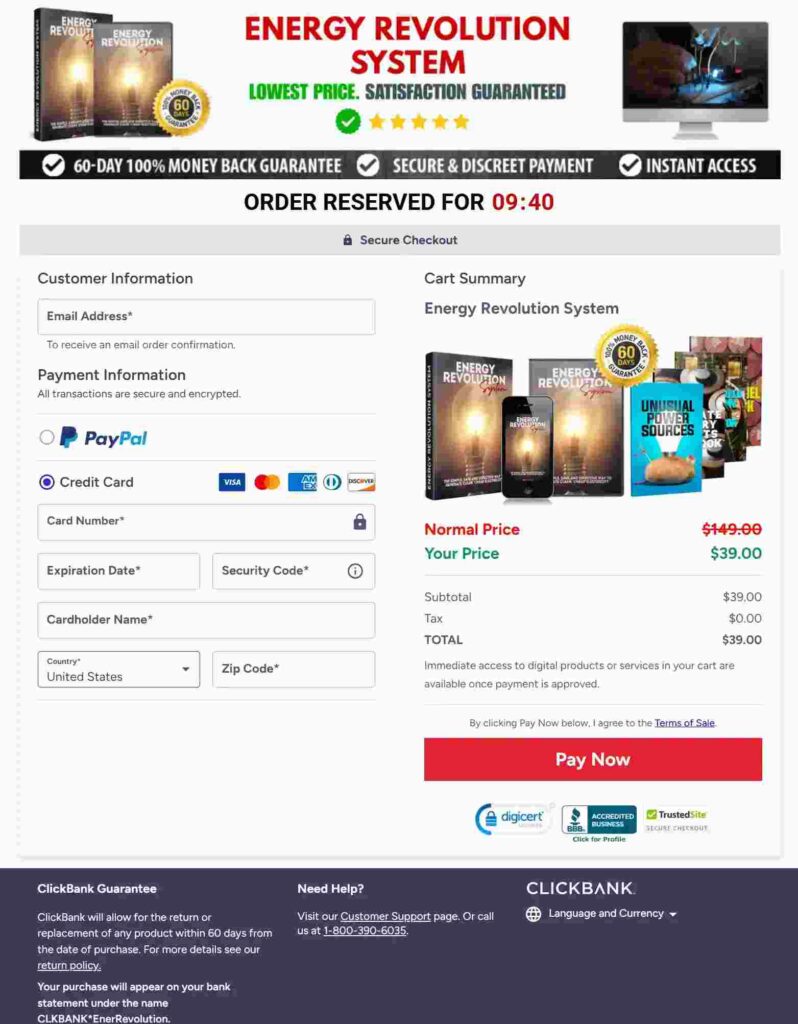
The Energy Revolution System is a digital product — not a physical device. When you purchase it from the official website, you receive a downloadable package containing:
- Step-by-step PDF blueprints and assembly guides
- Schematic diagrams for the electromagnetic coil setup
- A materials checklist of components sourced from hardware stores
- Video tutorials walking through the construction process
- A circuit diagram for connecting the device to low-wattage loads
The core concept is that buyers follow these instructions to build their own compact electromagnetic generator at home, using affordable, widely available components including copper wire, magnets, capacitors, diodes, and basic hardware. The vendor prices the guide at approximately $39, and materials costs are advertised at under $100–$200 depending on scale.
The product draws its central concept from the work of Nikola Tesla, specifically his 1894 patent for a bifilar pancake coil design. According to the vendor, building a device based on this design can meaningfully reduce household electricity consumption — with some marketing materials claiming reductions of 50% to 80%.
It is worth noting what the product is not: it is not a certified solar system, a commercial battery backup, or a grid-tied renewable energy installation. It is a DIY educational blueprint, and understanding that distinction is essential before evaluating any claim the marketing makes.
The Science Behind the Claims: Tesla’s Bifilar Coil Explained
To evaluate the Energy Revolution System honestly, it is necessary to understand what Tesla’s bifilar coil design actually does — and what it does not do.
What Tesla’s Patent Actually Says
On January 9, 1894, Nikola Tesla was granted U.S. Patent No. 512,340 — titled “Coil for Electro-Magnets.” The patent describes a coil wound using two parallel conductors connected in series, such that the end of the first wire connects to the beginning of the second. According to Tesla’s specification, this arrangement increases the distributed capacitance between turns, which in AC systems can help neutralize the negative effects of self-induction — the tendency of a coil to resist changes in current, which reduces commercial efficiency.
This is real engineering. As Tesla himself noted in the patent: “In electric apparatus or systems in which alternating currents are employed, the self-induction of the coils or conductors may…give rise to false currents which often reduce what is known as the commercial efficiency of the apparatus.”
Wikipedia’s entry on bifilar coils confirms the legitimate technical basis: bifilar coils are actively used in electrical engineering today, particularly in transformer design and common-mode filtering applications, precisely because of their unique relationship between distributed capacitance and self-inductance.
What the Science Supports — and What It Does Not
Here is where an honest review must draw a clear and important line.
Tesla’s bifilar coil is a real, useful, and genuinely interesting electrical engineering design. Building one is a legitimate, educational, and reasonably achievable DIY project. The coil can, when incorporated into a proper circuit, function as part of a low-output electromagnetic generator that produces a small, measurable electrical current.
However, the laws of thermodynamics remain immutable. No coil design — bifilar or otherwise — creates energy from nothing. The first law of thermodynamics, conservation of energy, establishes that energy cannot be created or destroyed, only converted from one form to another. A device inspired by Tesla’s coil design cannot produce more energy than it consumes. Claims of “over-unity efficiency” — where a small input produces a disproportionately large output — are not supported by established physics.
The Tesla Universe article on Tesla’s alternative geometry coil provides important context: while measurements confirm that Tesla’s bifilar design creates a more effective electromagnet with superior energy storage properties compared to standard single-wound coils, this translates to improved efficiency — not energy multiplication. There is a meaningful difference between an efficient coil and a self-sustaining power source.
What the Energy Revolution System can legitimately deliver, therefore, is a functional small-scale generator producing modest output — sufficient for low-wattage devices — that serves as a hands-on demonstration of electromagnetic induction principles. What it cannot deliver is whole-home energy independence or 50–80% reductions in electricity bills for typical households.
What the Vendor’s Own Disclaimers Reveal
One of the most revealing aspects of any product review is examining what the seller itself says about the product in its legal disclosures — information that is frequently overlooked in promotional reviews.
According to analysis of the vendor’s published terms, the Energy Revolution System is described in the company’s disclaimer as “an experiment” that has not been technically assessed and has not been individually or mass produced. That is the seller’s own characterization of the product.
The vendor’s fine print also states that the narrative presented in the sales materials is “created strictly for promotional purposes only.” This disclosure is significant: the dramatic origin story and claims about suppressed technology exist as marketing narrative, not verified historical documentation.
Additionally, the terms acknowledge that “some home alteration alternatives may be illegal in your town, city, state, province or country” — and that verifying local regulations is entirely the buyer’s responsibility.
These are not third-party criticisms. These are the vendor’s own words, and they frame the product appropriately: an experimental DIY blueprint with a compelling marketing narrative, not a certified, tested, or professionally validated energy system.
Safety and Legal Considerations: What Every Buyer Must Know
Before purchasing any DIY electrical project guide — not just this one — there are critical safety and legal realities that responsible consumers must understand.
Electrical Code Compliance
In the United States, most jurisdictions require permits and inspections for modifications to home electrical systems. Connecting any device to your home’s wiring without proper permits may violate local building codes. The specific requirements vary significantly by municipality, county, and state, so verifying with your local Authority Having Jurisdiction (typically your local building department) before beginning any electrical project is an essential first step.
Fire and Safety Risks
Working with electrical components — including copper wire, magnets, capacitors, and diodes — carries inherent risks. Poorly assembled circuits can cause electrical fires, equipment damage, or personal injury. These risks apply to all DIY electrical work and are not unique to this product, but they underscore why proper electrical safety practices are non-negotiable for any project in this category. If you lack experience with basic wiring and circuit assembly, consulting a licensed electrician before proceeding is strongly advisable.
Insurance Implications
Unpermitted electrical modifications can affect your homeowner’s insurance coverage. If an incident occurs involving an unpermitted alteration, your insurer may deny the claim. Verifying your policy’s stance on DIY electrical projects before proceeding protects your financial interests as well as your physical safety.
What Buyers Actually Receive: A Realistic Assessment
Setting aside both the promotional hype and the reflexive dismissiveness that characterizes much online commentary, a fair assessment of what buyers receive from the Energy Revolution System reveals the following:
The Genuine Positives
Clear, accessible instructions. Multiple reviews from buyers confirm that the guide’s instructions are well-organized and genuinely accessible to people without advanced technical backgrounds. The inclusion of diagrams, component-level explanations, and video tutorials reduces the learning curve considerably.
Affordable entry point. At $39 for the guide, with materials available for under $100–$150 from standard hardware stores, the financial barrier to entry is low. The 60-day money-back guarantee provides a meaningful safety net for buyers who find the product does not meet their needs.
Legitimate educational value. Building the device successfully produces a measurable, real electrical output — enough to power LED lighting, USB chargers, or other low-wattage devices. For hobbyists, students, and DIY enthusiasts, this constitutes a genuinely satisfying hands-on introduction to electromagnetic induction and Tesla’s coil design principles.
Grounded in real science. Unlike some energy products that are purely fictional, the bifilar coil at the foundation of this guide has documented engineering applications. Building one, even at a small scale, provides authentic exposure to principles that underpin modern transformer design and electrical engineering.
The Significant Limitations
Output is strictly supplemental, not transformational. The device produces enough electricity to power low-draw devices — LED strips, phone chargers, small fans, modems. It will not run a refrigerator, air conditioner, washing machine, or any other high-wattage appliance. The marketing claim of 50–80% bill reductions has no credible basis for typical household use.
Marketing substantially overstates the product. The gap between what the advertising claims and what the product delivers is considerable. Buyers who approach this product expecting to achieve meaningful energy independence will be disappointed. Buyers who approach it as a hands-on educational experiment in electromagnetic principles will find it satisfying and worthwhile.
Ongoing costs exist. Materials must be sourced separately, and scaling up for greater output requires additional investment. The $39 purchase price is the beginning of the cost, not the entirety of it.
Not a substitute for professional energy solutions. Buyers with genuine interest in reducing their energy bills by 50% or more would achieve far better results — and far greater reliability — through certified solar installations, battery storage systems, or energy efficiency improvements to their homes.
░▒▓█ ➤🔗Visit The Official Website – Save money, save the planet—start your DIY energy system!🔴
Who Is the Energy Revolution System Actually For?
Having assessed the product honestly, it is possible to identify the audience for whom it represents genuine value:
DIY enthusiasts and hobbyists who enjoy building functional projects and find satisfaction in hands-on experimentation. For this audience, the Energy Revolution System delivers on its promise of a buildable, working electromagnetic device.
Students and educators looking for a practical, affordable introduction to electromagnetic induction principles, Tesla’s engineering legacy, and basic circuit assembly. The guide provides a more engaging entry point into these concepts than textbook study alone.
Emergency preparedness enthusiasts who want to build a supplemental power source capable of keeping essential low-wattage devices — lights, communication devices, chargers — running during outages. In this context, the system’s limited output is appropriate and useful.
Curious homeowners who want to understand energy generation at a fundamental level and are willing to invest a weekend in a project that teaches them something genuinely valuable about physics, even if it does not dramatically reduce their power bills.
The product is not well-suited for homeowners seeking serious, reliable energy cost reduction; families dependent on power for medical equipment or critical appliances; or anyone expecting to replace grid electricity with a DIY coil assembly.
Proven Alternatives for Genuine Energy Independence
For readers whose primary goal is meaningfully reducing their electricity bills or achieving greater energy independence, several certified, professionally validated alternatives exist and consistently deliver the results that the Energy Revolution System’s marketing promises but cannot realistically provide.
Residential Solar Panel Systems
Solar photovoltaic systems remain the most accessible and widely proven path to significant electricity bill reduction for homeowners. According to the U.S. Energy Information Administration, the average American household spends $144 to $163 per month on electricity. A properly sized residential solar installation — typically costing $15,000–$25,000 before incentives — can reduce or eliminate that cost over a 20–25 year lifespan, with federal tax credits currently offsetting 30% of installation costs.
Battery Storage Systems
Home battery systems such as the Tesla Powerwall, LG RESU, or Sonnen battery allow homeowners to store solar-generated electricity or off-peak grid power for use during peak hours, significantly reducing demand charges and providing emergency backup power. These systems are certified, tested, and professionally installed — entirely different from experimental DIY guides.
Energy Efficiency Upgrades
Before investing in any supplemental generation system, addressing the root causes of high electricity consumption typically delivers the most cost-effective results. LED lighting, smart thermostats, improved insulation, energy-efficient appliances, and behavioral adjustments can reduce consumption by 20–30% at a fraction of the cost of any generation system.
Community Solar Programs
For homeowners who cannot install rooftop solar due to renting, roof orientation, or HOA restrictions, community solar programs allow participants to subscribe to a portion of an off-site solar installation and receive credits on their utility bills. These programs are available in a growing number of states and represent a zero-installation path to renewable energy savings.
Frequently Asked Questions
Is the Energy Revolution System a scam?
The product delivers what it fundamentally promises — a downloadable guide with instructions, diagrams, and materials lists for building a small electromagnetic generator. In that sense, it is not fraudulent. However, the marketing substantially overstates the realistic outcomes, and buyers should calibrate their expectations accordingly. The vendor’s own disclaimer characterizes the product as an untested experiment with a promotional narrative.
Does the device actually generate electricity?
Yes. When built correctly, the device generates a small, real electrical output through electromagnetic induction. Multiple user reports confirm that it can power LED lighting, USB chargers, and similar low-wattage devices. It does not generate enough electricity to power major appliances or meaningfully reduce household electricity bills.
Is it safe to build?
DIY electrical projects carry inherent risks. Working with wiring and electrical components without experience increases those risks. Anyone without basic electrical knowledge should consult a qualified electrician before attempting the project, and all local electrical codes and permit requirements should be verified before connecting any homemade device to a home’s electrical system.
Can I get a refund if I’m not satisfied?
The vendor advertises a 60-day money-back guarantee. As with any digital product, buyers should retain documentation of their purchase and contact customer support within the stated window if they wish to request a refund.
Why does Tesla’s bifilar coil matter to electrical engineering today?
Tesla’s bifilar coil design (U.S. Patent 512,340) has genuine, documented applications in modern electrical engineering, particularly in transformer design and common-mode noise filtering. It is studied and applied by electrical engineers today because of its unique relationship between distributed capacitance and self-inductance. However, its practical applications are in efficiency optimization — not in generating electricity beyond what physics allows.
What is the real cost of the Energy Revolution System?
The guide itself costs approximately $39. Materials sourced from hardware and electronics stores typically add $80–$200, depending on the scale of the build. Total initial investment therefore ranges from approximately $120 to $240. This does not include tools such as a multimeter or soldering equipment if not already owned.
Verdict: An Honest Summary
The Energy Revolution System occupies a specific and legitimate niche that its marketing substantially misrepresents. As a hands-on DIY educational project rooted in genuine electromagnetic principles, it offers real value to hobbyists, students, and experimenters who approach it with appropriate expectations. The guide is well-organized, the science it draws on is real, and the building experience is genuinely satisfying.
As a serious energy independence solution, however, it falls far short of what its advertising promises. The 50–80% bill reduction claims are not credible for typical households. The device produces supplemental power for low-wattage devices — a useful and interesting achievement, but a fundamentally different proposition from the energy freedom the marketing narrative describes.
The most important takeaway is this: the product’s value lies in the experience of building it and learning from it, not in the energy output it produces. Buyers who internalize that distinction before purchasing are likely to find the experience worthwhile. Buyers who purchase expecting to cut their power bills in half will be disappointed.
For those seeking genuine, substantial reductions in electricity costs, certified solar installations, battery storage systems, and energy efficiency upgrades remain the evidence-backed, professionally validated path forward.
░▒▓█ ➤🔗Visit The Official Website – Save money, save the planet—start your DIY energy system!🔴