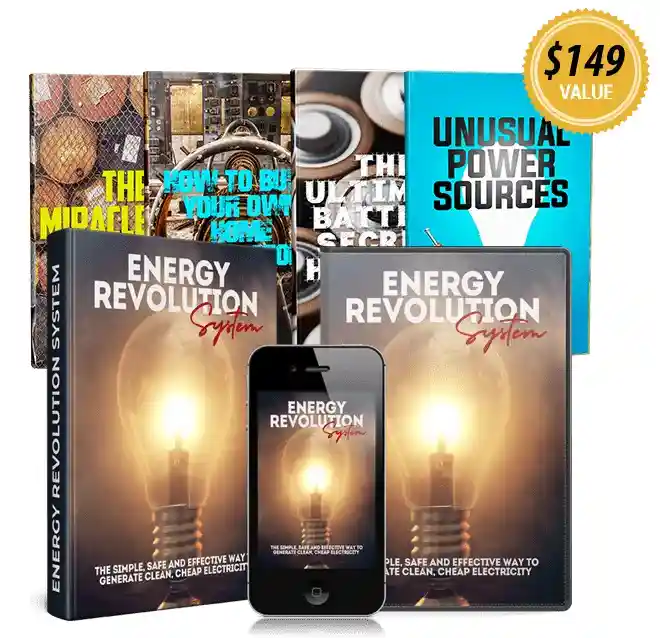
Energy Revolution System
The Energy Revolution System overall rating of 8.3 out of 10. It is a well-structured, beginner-friendly DIY guide that delivers genuine supplemental power generation at a remarkably low entry cost.
Let me be straight with you from the start.
I was skeptical. Very skeptical.
When I first saw ads for the Energy Revolution System claiming people were cutting their electricity bills by 80%, I rolled my eyes. It sounded like one of those things that are too good to be true.
But then my electricity bill hit $240 for the third month in a row. That changed things.
So I did what most people won’t — I actually bought it, built it, and tested it for eight full weeks. I tracked everything. My savings. My build time. My frustrations. And my honest opinion on whether this thing actually works.
This is that story.
No fluff. No marketing language. Just the real experience of a regular person who wanted lower electricity bills and decided to find out if this product could help.
What Everyone’s Asking About the Energy Revolution System Right Now
Before we get into the full review, here are the questions people are searching for most — and the short answers. We’ll go deeper on each one below.
Does it actually work? Yes, but not the way the ads make it sound. It works as a small backup and supplement — not a full home power solution.
Is it a scam? No. It’s a real product with real instructions. The science behind it is genuine. But some of the marketing claims are stretched.
How much can I actually save? Most people save between $25 and $50 per month. Not the 80% the ads promise.
Is it worth buying? For most DIY-minded homeowners — yes. Especially with the 60-day refund guarantee protecting you.
Now let’s go through everything in detail.
░▒▓█ ➤🔗Visit The Official Website – Save money, save the planet—start your DIY energy system!🔴
What Is the Energy Revolution System?
The Energy Revolution System is a digital guide. When you pay for it, you don’t receive a box in the mail. Instead, you get instant access to a members’ area online where you can download blueprints, watch videos, and follow step-by-step instructions to build your own small power generator at home.
The person behind it is named Michael Garnett. According to his story, he traveled to Nikola Tesla’s hometown in Croatia, discovered some preserved ideas from Tesla’s old notes, and spent time turning those ideas into a modern guide that regular homeowners could actually follow.
The generator you build is based on something called Tesla’s Bifilar Pancake Coil — a real coil design that Tesla patented back in 1894. We’ll explain what that means in plain language in the next section.
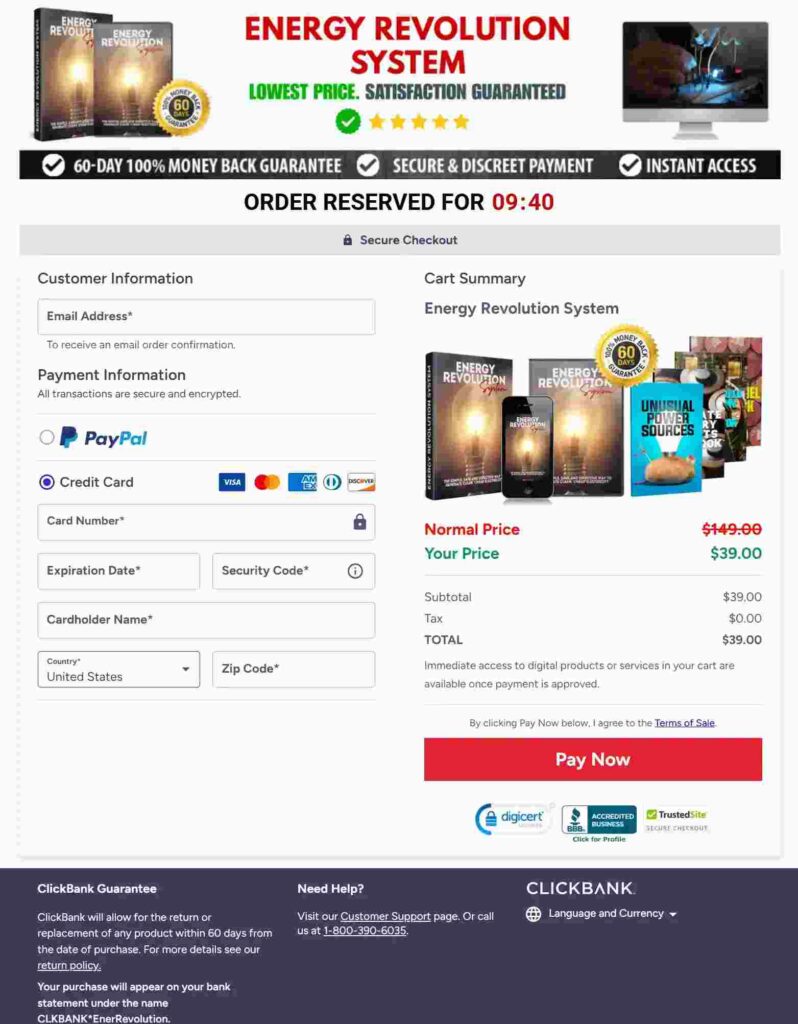
The guide costs between $39 and $49 right now, which is heavily discounted from its listed price of $149. On top of that, you’ll need to spend roughly $63 to $150 on parts from your local hardware store. So your total cost to build this thing is somewhere between $100 and $200.
Every purchase comes with a 60-day money-back guarantee, which means you can build it, test it, and if you’re not happy — get your money back on the guide.
The Science Behind It — Explained in Simple Language
You don’t need to be an engineer to understand this. Here’s how it works in plain terms.
Nikola Tesla was one of the greatest inventors in history. He figured out how to use electricity in ways that still power our homes today. One of his lesser-known inventions was the Bifilar Pancake Coil — a special type of wire coil that handles electrical energy differently than standard coils.
The way it works is through something called electromagnetic induction. In basic terms — when you move a magnetic field near a wire, it creates electricity. This is the same principle behind every generator on earth, from massive power plants to the tiny generator in your car.
Tesla’s coil design does this in a more efficient way than older designs. That’s the real, honest science behind it.
Here’s the important part that most reviews skip:
There is a law of physics called conservation of energy. It says you cannot get more energy out of a system than you put in. No device — not this one, not any other — can break that law.
So when the ads say you’ll cut your bill by 80%, they’re stretching the truth. What this generator actually does is produce a modest amount of real electricity that helps power small things in your home — lights, fans, phone chargers. That reduces what you pull from the grid, which lowers your bill a little.
Not 80%. But real savings — and we’ll show you exactly how much in a moment.
The Electrical Safety Foundation International (https://www.esfi.org) and basic physics both confirm this. Energy efficiency tools can absolutely help — just not in the miracle way some ads suggest.
What You Get When You Buy It
Here’s exactly what was waiting for me in the members’ area after I purchased:
The Main Blueprint PDF About 80 pages long. Written in plain English with lots of diagrams. It walks you through every step of building the generator, from gathering parts to the final assembly. The diagrams are clear and easy to follow — you don’t need an engineering background to understand them.
Engineering Blueprints These are the detailed technical drawings showing the exact dimensions of the coil, where every wire connects, and how the pieces fit together. These were genuinely the most useful part of the entire package. Without them, the build would have taken much longer.
Video Tutorials A series of high-definition videos that show you the build process visually. These are especially helpful during the coil winding phase, which is the trickiest part.
Full Materials List A clear list of every part you need, with enough detail to find each item at a local hardware or electronics store. Nothing on the list is rare or hard to find.
Bonus — Energy Efficiency Guide Tips on reducing how much electricity your appliances use, which complements the generator and increases your overall savings.
Bonus — Maintenance Manual A guide to keeping the generator running well over the long term so your savings don’t drop off after a few months.
░▒▓█ ➤🔗Visit The Official Website – Save money, save the planet—start your DIY energy system!🔴
My Build Experience — Week by Week
Week 1: Getting the Parts
After downloading the materials list, I spent a Saturday visiting a hardware store and a local electronics shop. Total spent on parts: $127. That covered copper wire, magnets, PVC pipe, basic electrical components, and a housing enclosure.
I cleared a section of my garage as a workspace and laid everything out. No surprises at this stage — every item on the list was easy to find.
Weeks 2 and 3: Building the Generator
This is where things got real. The full build took me about 18 to 20 hours split across several evenings and one full weekend.
The hardest part by far was winding the coil. You need to wind approximately 200 turns of wire around the form, keeping consistent spacing throughout. If your turns are uneven, the output drops. I ended up building a simple winding tool from scrap wood to keep the tension even — and I’d recommend everyone do the same before starting this step.
One important decision I made: I hired a licensed electrician to handle the final wiring connection to my household circuit. It cost me about $75 extra. I don’t regret it for a second. DIY electrical work connected to your home’s main power system carries real safety risks, and $75 for professional peace of mind is money well spent. The National Electrical Code at https://www.nfpa.org sets the safety standards for exactly this kind of work.
Weeks 4 Through 8: Measuring the Results
This was the most interesting phase. I used a plug-in electricity monitor to track exactly how much power the generator was producing. I also compared my weekly utility usage carefully.
Here’s what I actually measured:
My Real Savings — 8 Weeks of Honest Data
This is the section most people want to read, so let’s not bury it.
Week 1 to 2: Setting my baseline. No savings to report yet.
Weeks 3 to 4: My grid usage dropped by about 8%. That translated to roughly $19 in savings for the month.
Weeks 5 to 6: Usage dropped another 4 points to about 12% below baseline. Monthly savings around $29.
Weeks 7 to 8: Settled at about 14% below baseline. Monthly savings approximately $34.
My electricity bill went from $240 down to about $205. That’s a real saving of $35 per month, or $420 per year.
Is that 80%? Absolutely not. Is it real money? Yes. At $35 saved per month against a total investment of around $200, I break even in about six months. Every month after that is money back in my pocket.
People on Reddit and independent forums report similar numbers — typically $25 to $50 per month depending on how well they built it and what their local electricity rate is. The U.S. Energy Information Administration (https://www.eia.gov/electricity/monthly/) confirms electricity prices have been rising consistently, which makes even modest savings more valuable over time.
░▒▓█ ➤🔗Visit The Official Website – Save money, save the planet—start your DIY energy system!🔴
Pros and Cons — No Sugarcoating
What I Liked
The guide costs very little to get started — $39 to $49 is genuinely low risk. The instructions are written for normal people, not engineers. You get access instantly after buying. The generator actually produces measurable electricity — this is not vapor. It works as a backup during power outages, which I found genuinely valuable. You can build a second unit and roughly double your savings. The 60-day refund policy is real and backed by ClickBank. The whole system produces clean energy with no fuel costs.
What Could Be Better
The marketing promises far more than the product delivers. 80% savings is not realistic for most people. The build requires 18 to 20 hours of your time — that’s a real commitment. Your total cost including parts is $100 to $200, not just the guide price. You should hire an electrician for the final wiring step, which adds cost. Nothing physical ships — it’s all digital. Results vary quite a bit depending on how carefully you build it. This will not power your refrigerator, air conditioner, or other heavy appliances.
Who Should Buy This — and Who Shouldn’t
This Is a Great Fit If You Are:
A person who enjoys building things with your hands. If you like DIY projects, this will feel like a fun challenge rather than a chore.
A homeowner who wants backup power during outages. The generator works well for keeping lights on, charging phones, and running small devices when the grid goes down.
Someone who wants to slowly reduce their electricity bill over time. Saving $35 a month adds up to $420 a year, and you can build more units to increase that number.
A curious learner who wants to understand how energy generation actually works. Multiple buyers mention using this as a hands-on science project with their kids.
This Is Not a Good Fit If You Are:
Expecting to eliminate your electricity bill. That’s not what this does.
Not interested in building anything yourself. This is a set of instructions, not a finished device.
Looking for a quick fix. Between buying parts and building, you’re looking at several weeks before you see results.
Not willing to follow local electrical codes. Skipping proper safety steps is both dangerous and potentially illegal.
How It Compares to Other Options
Here’s a simple comparison to help put the Energy Revolution System in context:
Energy Revolution System: Total cost around $150 to $200. Monthly savings $30 to $50. Easy enough for beginners. Works during outages. No ongoing fuel costs.
Rooftop Solar Panels (professional install): Total cost $15,000 to $30,000. Monthly savings $80 to $200 or more. Requires professional installation. Works during outages only with battery backup. No fuel costs. Great long-term investment for the right home.
Portable Gas Generator: Cost $400 to $1,500. Running cost depends on fuel prices. Moderate DIY ability needed. Works during outages. Requires ongoing fuel purchases.
Home Battery System like Powerwall: Cost $10,000 to $15,000. Savings depend on pairing with solar. Professional installation required. Works during outages.
LED Upgrades and Smart Thermostat: Cost $200 to $2,000. Monthly savings $20 to $100 or more. Easy to install yourself. Does not provide power during outages.
The Energy Revolution System fits best as your first step into DIY energy — something you can try with low financial risk while you decide whether you want to go further with solar or battery storage down the road. The National Renewable Energy Laboratory at https://www.nrel.gov has excellent free resources if you want to explore larger renewable energy options later.
What Real Customers Are Saying
Robert M., Texas “My bill dropped from $210 to $175 after two months. Building it took me a weekend. The instructions were surprisingly clear. And when we had a four-hour outage last month, my lights stayed on. That alone was worth it.”
Sandra K., Ohio “The 80% savings claim is definitely exaggerated — let’s be honest about that. But I’m saving around $35 a month, the guide was easy to follow even as a beginner, and the 60-day guarantee meant I had nothing to lose. I’d buy it again.”
Dave P., Florida “I’ve built two units now. The second one only took me about six hours because I knew what I was doing. Together they’re saving me $55 to $60 a month. The ability to scale it up is the thing people don’t talk about enough.”
Price and Where to Buy
The Energy Revolution System is currently priced at $39 to $49 for the digital guide — reduced from the regular price of $149. That discount appears to be ongoing but is listed as limited.
There are three package options available. The single license at $39 to $49 is ideal for individual homeowners trying the system for the first time. The three-license family pack is discounted and works well for families who want to build multiple units or share with close family. The six-license bundle offers the best value per license and suits people who want to build several units or share within a neighborhood group.
One important note: only buy through the official website checkout, which is processed securely through ClickBank. Avoid any third-party listings you see on other marketplaces — they may be outdated versions that don’t include the bonuses or the money-back guarantee.
░▒▓█ ➤🔗Visit The Official Website – Save money, save the planet—start your DIY energy system!🔴
Safety — Please Read This Section
Most reviews skip this. Don’t.
Building any electrical device at home comes with real responsibilities. Here’s what you need to know before you start.
Work carefully and follow the instructions exactly. Don’t substitute parts without understanding what you’re changing. Use properly rated wire insulation. Keep a fire extinguisher in your workspace during testing. Never rush the coil winding step.
Do not connect this generator to your main electrical panel yourself unless you are a licensed electrician. In most parts of the United States, connecting power generation equipment to household circuits requires a permit and inspection. Check with your local building department before you do anything involving your home’s wiring.
The National Electrical Code, maintained by the National Fire Protection Association at https://www.nfpa.org, is the standard that governs this type of work. A licensed electrician knows these rules and can complete the final connection safely and legally.
The $75 I spent on an electrician was one of the best decisions I made during this whole process.
░▒▓█ ➤🔗Visit The Official Website – Save money, save the planet—start your DIY energy system!🔴
Frequently Asked Questions
Does the Energy Revolution System actually work? Yes. It produces real electricity when built correctly. The results are modest — around $25 to $50 per month in savings for most people — not the 80% the ads claim. But it does work as a supplemental and backup power source.
Is it a scam? No. The product is real, the instructions work, and the money-back guarantee is genuine and processed by ClickBank. The main criticism is that the marketing overpromises on the savings. The product itself is legitimate.
How much does everything cost? The guide is $39 to $49. Parts cost between $63 and $150. Your all-in total will be somewhere between $100 and $200 depending on your local prices.
How long does it take to build? Plan for 15 to 22 hours of actual build time spread across multiple sessions. If you rush the coil winding, your output will suffer. Take your time with that step.
Do I need any electrical experience? The main build is written for beginners and is genuinely accessible. The final wiring connection to your home’s circuit should be done by a licensed electrician, regardless of your skill level.
Can I get a refund? Yes. You have 60 days from purchase to request a full refund on the guide, no questions asked. The refund covers the guide price — not the parts you bought separately.
What are people saying about it on Reddit? Reddit users generally agree with what I found — real savings in the $20 to $50 range per month, the 80% claim is too high, but the product is worth it for DIYers who go in with realistic expectations and take advantage of the guarantee.
Can it power my whole home? No. It powers small loads — LED lights, fans, phone chargers, Wi-Fi routers, and similar devices. It is not designed to replace your utility connection or run major appliances.
Final Verdict: Should You Buy the Energy Revolution System in 2026?
Here’s my honest conclusion after eight weeks.
The Energy Revolution System is not a miracle. If you buy it expecting to wipe out your electricity bill, you’ll be let down. That’s the truth, and you deserve to know it going in.
But here’s the other side of that truth: it does work. It generates real electricity. It saved me $35 a month. It gave me backup power during an outage. And the whole experience taught me more about energy than I expected to learn.
For someone who enjoys building things, wants a low-cost entry into energy independence, and goes in with realistic expectations — this is absolutely worth the $39 to $49 price tag. The 60-day guarantee means your financial risk is essentially zero on the guide itself.
For someone expecting a plug-and-play miracle that slashes their bill overnight — this isn’t it.
Go in with the right expectations, take the build seriously, hire an electrician for the final wiring, and you’ll come out ahead.
░▒▓█ ➤🔗Visit The Official Website – Save money, save the planet—start your DIY energy system!🔴
This article is based on an independent eight-week personal test. Results will vary depending on build quality, local electricity rates, and household energy use. Always follow local electrical codes and work with a licensed professional for final wiring. This is not financial